Data Taste
Estimated time to complete: 45 minutes

Estimated time to complete: 45 minutes
The Earth Systems Research Laboratory’s Global Monitoring Laboratory of the of the National Oceanic and Atmospheric Administration (NOAA) conducts research that addresses three major challenges; greenhouse gas and carbon cycle feedbacks, changes in clouds, aerosols, and surface radiation, and recovery of stratospheric ozone.
Visit this page to begin exploring datasets
Locate the “Research Tab” within the blue header banner and choose “Ozone and Water Vapour” and click on the tab to bring you to the landing page. https://gml.noaa.gov/ozwv/
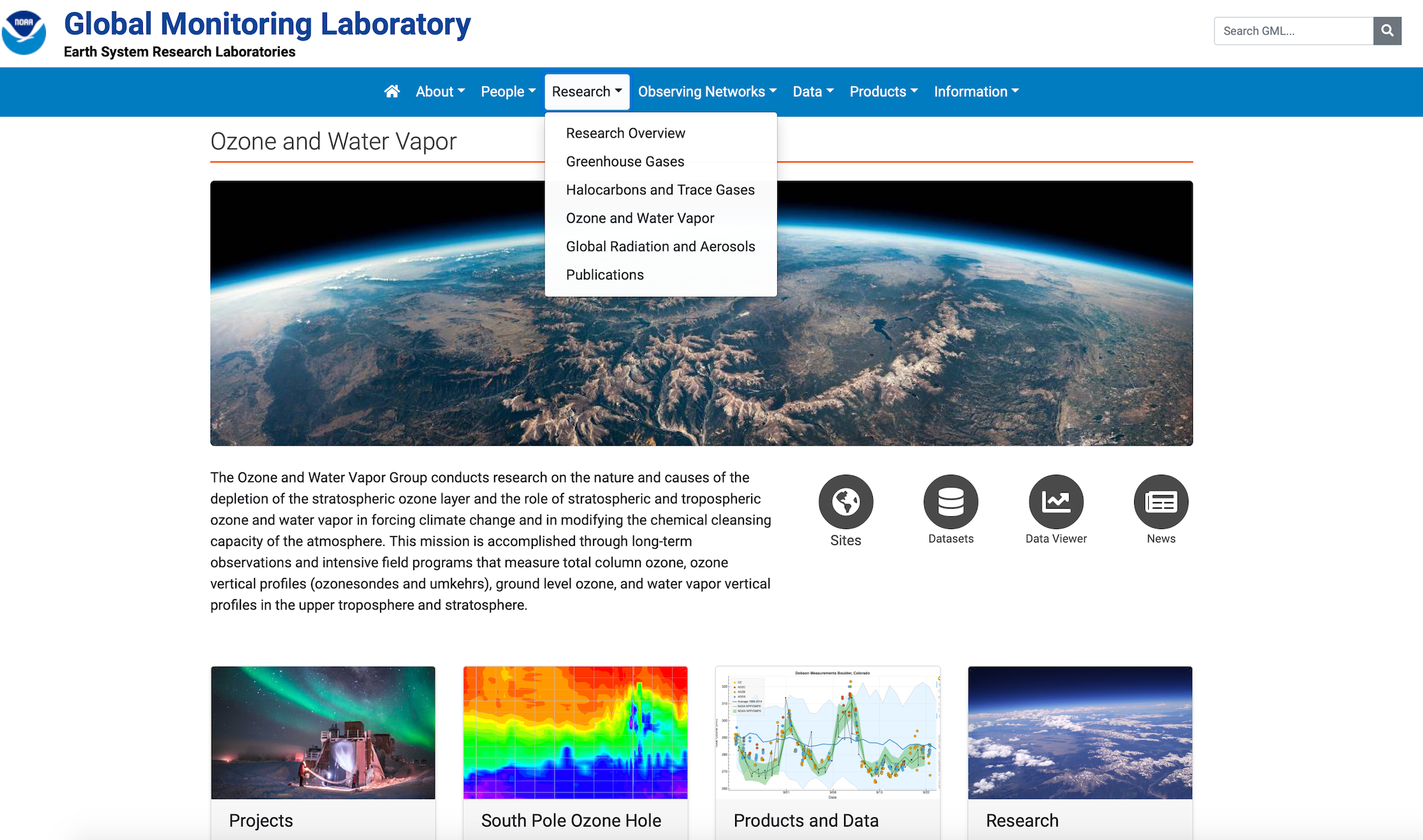
In this DataTaste you will be exploring Ozone data. Locate the circular widgets on this page to select “Data Viewer”. Once you select “Data Viewer” you will be relocated to a world map of all locations that various Ozone and Water Vapour data is collected.
Begin by exploring a few different locations around the globe for Ozone data. You can change the location of the data you would like to view by clicking the “Select a Sampling Location from the List or Map” which is the first dropdown menu on the page.
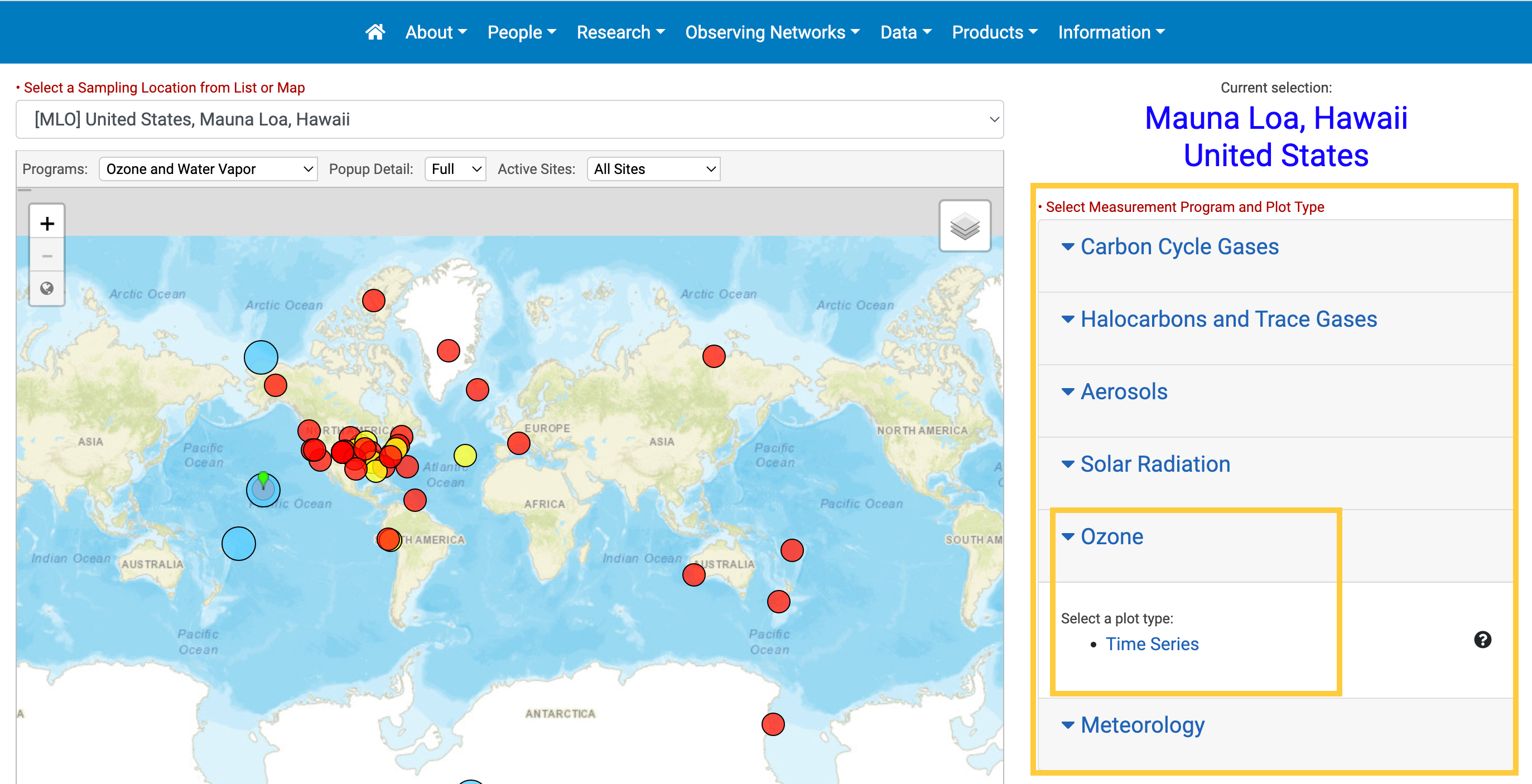
Utilize the location dropdown menu to practice switching different sites around the globe. Use the mouse to hover over locations on the map to understand the different atmospheric measurements that are monitored at that site.
The first location to explore is the code (MLO) Mauna Loa, Hawaii

Once you have changed the location to Mauna Loa, Hawaii you will see data tabs in grey boxes on the right-hand side. Click the down arrow under “Ozone” to reveal “Time Series”. Select “Time Series” to be redirected to a data plotter.
You are now finished Step 1. Great job!
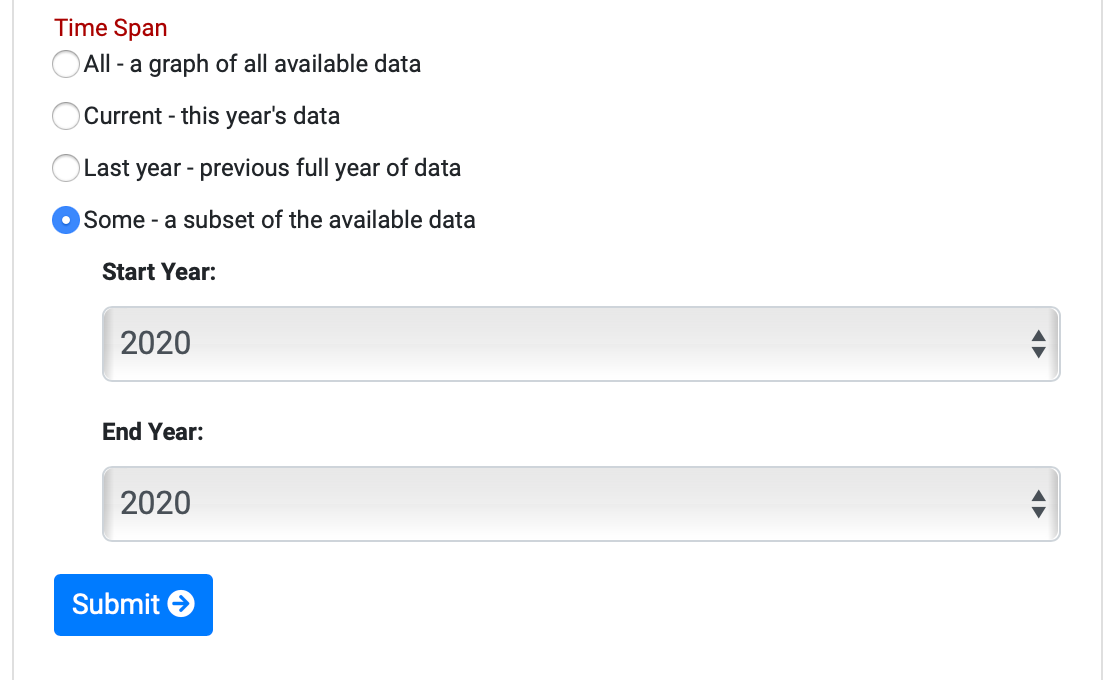
The DataPlotter function allows you to look at different time spans of data to look graphically at trends and see the data projected in line graph format. Let’s first subset the data for a particular set of years. You can do this by choosing “Some- a subset of available”
Click on “subset of available” and choose a single year of 2020. Click the blue button at the bottom labelled “Submit” for the graph to appear in the right-hand column.
In the right hand of your screen you will see a graph for a single year beginning in January and ending in December appear.
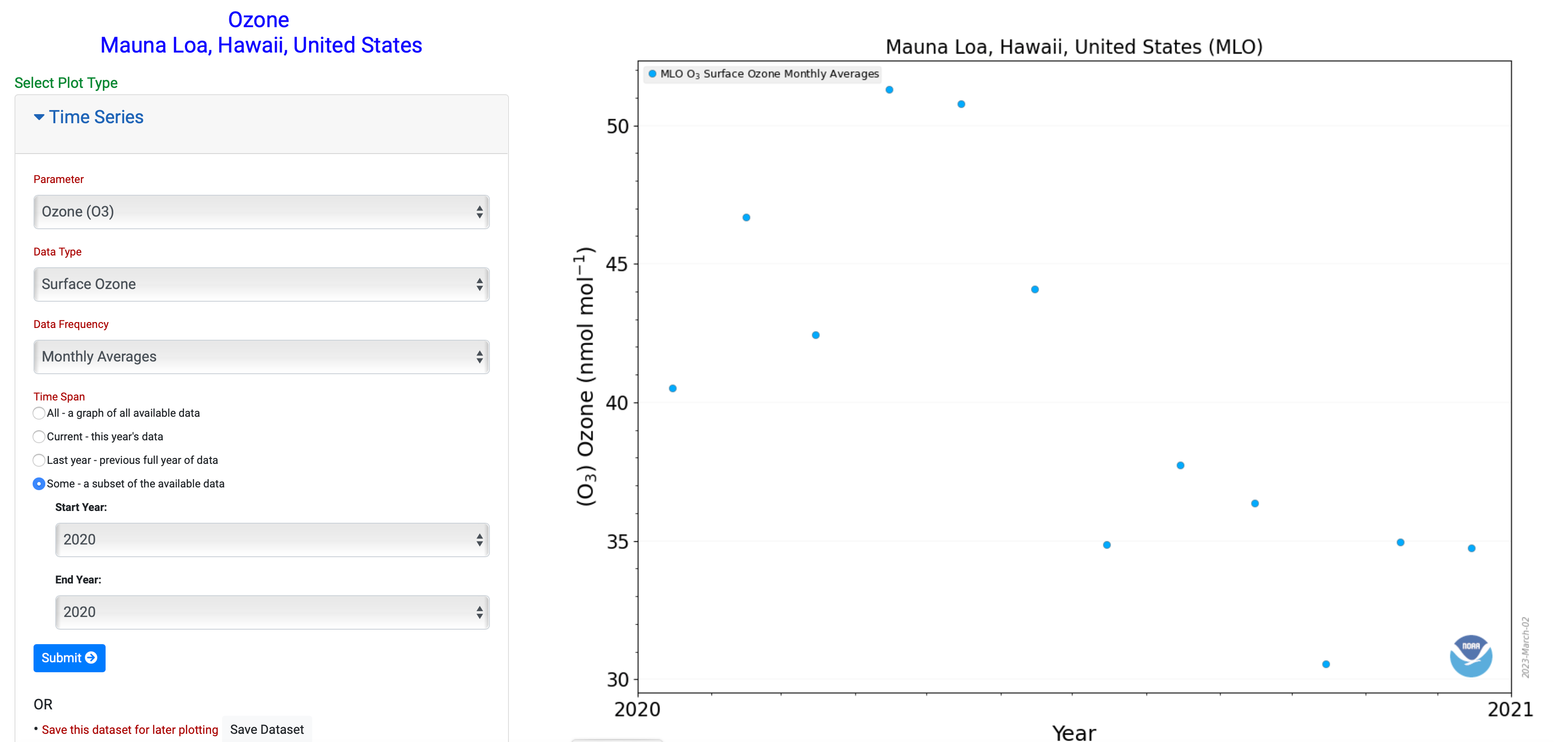
What month is ozone the highest for station Mauna Loa, Hawaii?
What month is ozone the lowest for station Mauna Loa, Hawaii?
Once you have answered the prompt go to the bottom left-hand corner of the graph to create a .PDF version for your analysis.
Save this graph as Mauna_Loa_Hawaii_2020_Ozone.
The next step is to utilize the data plotter to see if trends seen in one year, hold over multiple years. To do this in the DataPlotter go to “Some- a subset of the available data” and choose the year of 2015 to 2020.
*Note to make sure you are still in the correct data location of Mauna Loa, Hawaii.
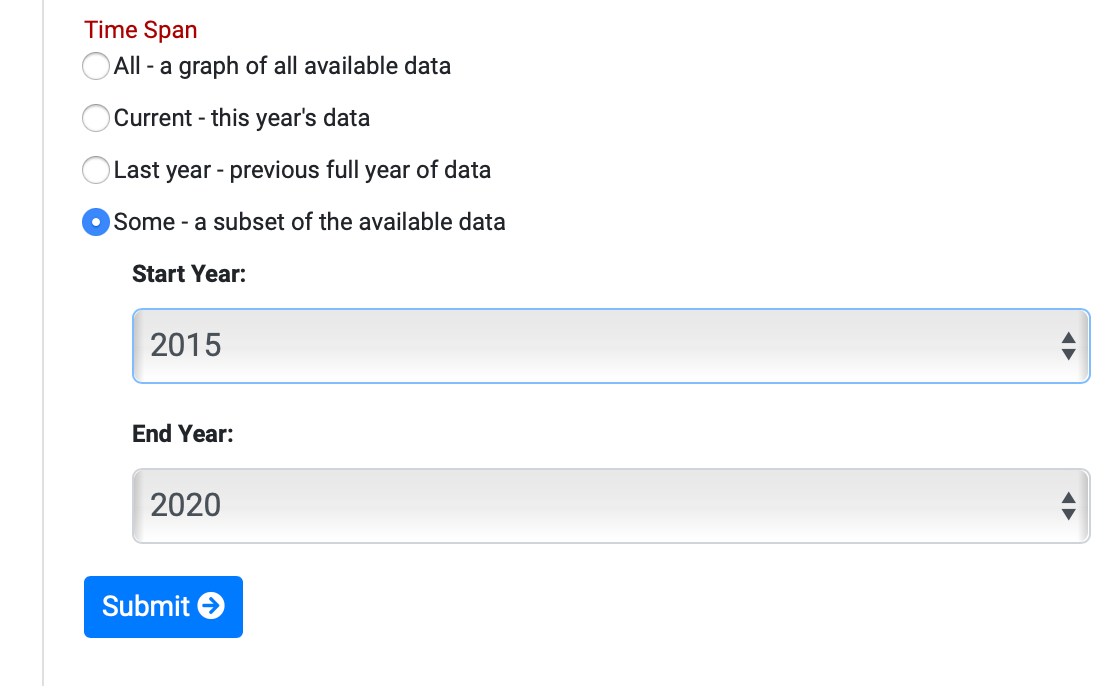
Investigate the trends, what times of year are the highest in Ozone, lowest? Is there a seasonal trend from 2015-2020?
Make sure to write down notes for the trends that you see in the data.
Additionally record what a “high” value is for this location and ensure to note your units of measurement of ozone found on the "y-axis".

Save your graph by utilizing the create a .PDF version for your analysis.
Save this graph as Mauna_Loa_Hawaii_2015_2020_Ozone.
Now you know how to subset data for a single location and timespan.
The next location to explore is Greenland, Summit (Code: SUM).
In the upper right-hand corner in small blue print, you will see the listing of “Site Selection”. This will allow the user to select a new location to further explore Ozone.
Choose SUM Summit Greenland.

What month is ozone the highest for station Greenland, Summit?
What month is ozone the lowest for station Greenland, Summit?
Save your graph as Summit_Greenland_2020_Ozone.
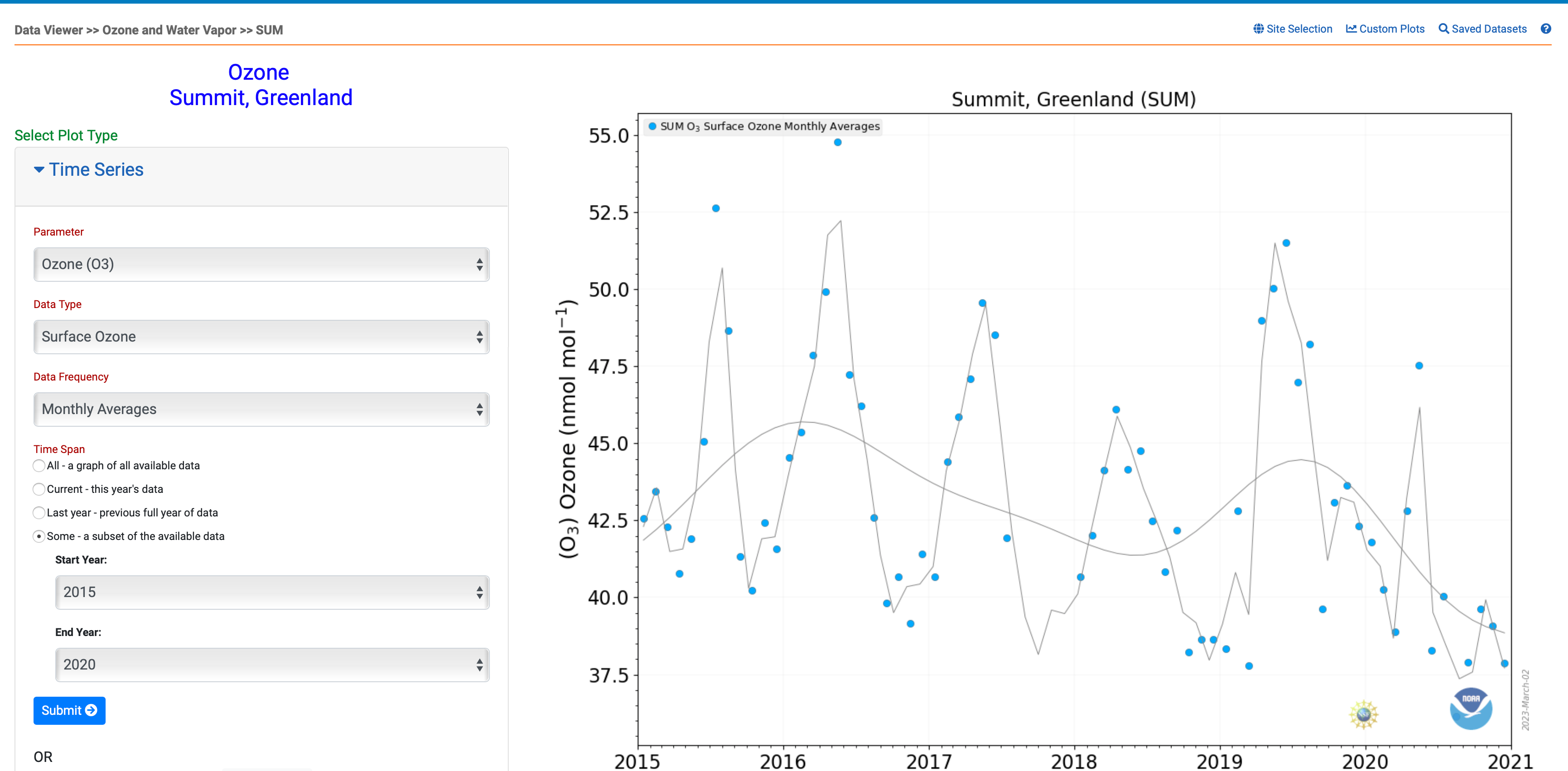
Next practice subsetting the data by the year range of “2015-2020” and look for seasonal trends.
Save your graph as Summit_Greenland_2015-2020_Ozone
Investigate the trends, what times of year are the highest in Ozone, lowest? Are there seasonal trends from 2015-2020? Record notes on the trends that you see in these data.
Additionally record what the “high” and “low” values are for this location and the units that ozone was measured in, which can be found on the y-axis of the graph.
What happens when “All- a graph of all available data” is selected in the left hand panel for Summit, Greenland do those same trends appear in the larger dataset (2000-present)?
Utilize a program such as a PowerPoint or Google Slide to allow you to see graphs side by side.
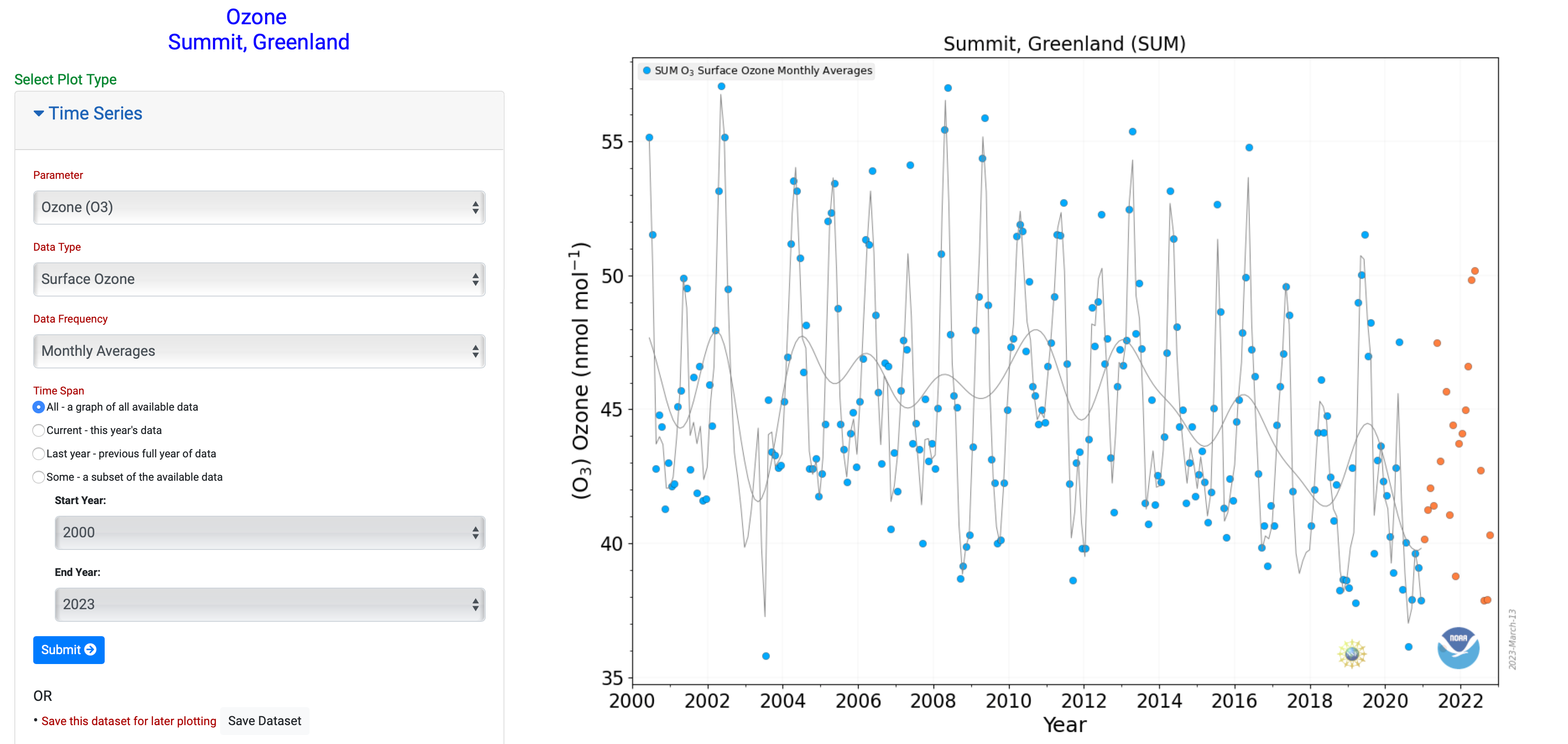
The graphs produced in step 3 and 4 lay the groundwork to understand how atmospheric circulation patterns may affect the amount of surface Ozone recorded at these locations. Spring (April, May) have been recorded has having the highest values of Ozone (PPB) for both locations. Let’s look at the meteorology of Hawaii to begin to draw some conclusions.
Navigate to Earth Null School
Earth Null school is a website that provides a visualization of global weather conditions using data from various models. This tool will enable you to explore larger patterns in the data collected in this lesson. The landing page should look like the image below. Click the “Earth” in the bottom left-hand corner of the page to open the data window.
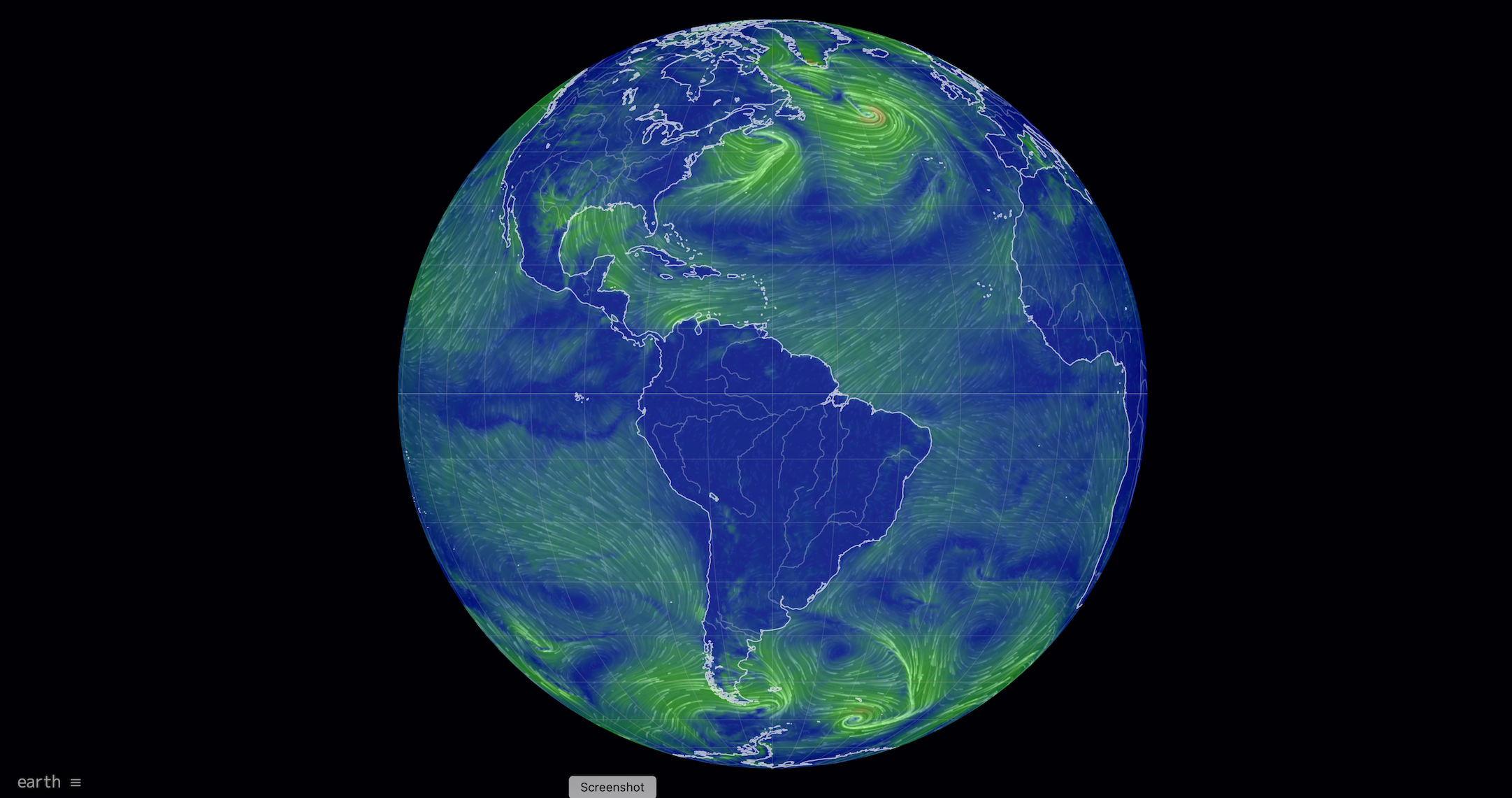

The map should look similar to the below. Proceed to practice moving the globe around and zooming in to different locations. Take some time to investigate the overlays and get familiar with this tool.

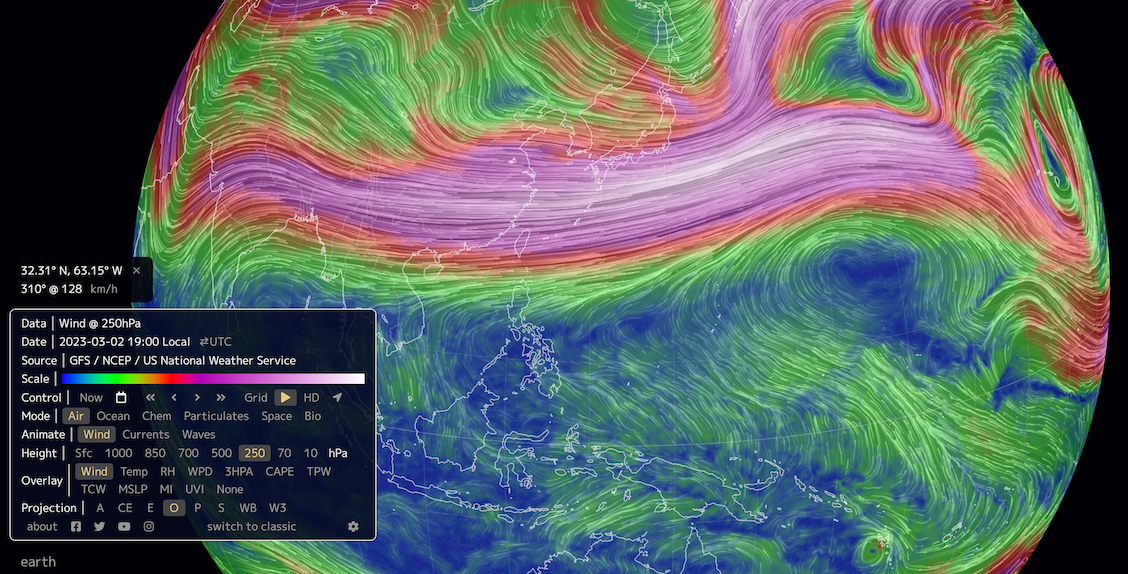
The jet streams are fast-moving, narrow bands of air currents in the upper atmosphere that flow from west to east. There are two main jet streams, the polar jet stream and the subtropical jet stream.
Earth Null School has a function to look at historical data. Navigate to Control on the left-hand side of the data panel and locate the calendar.
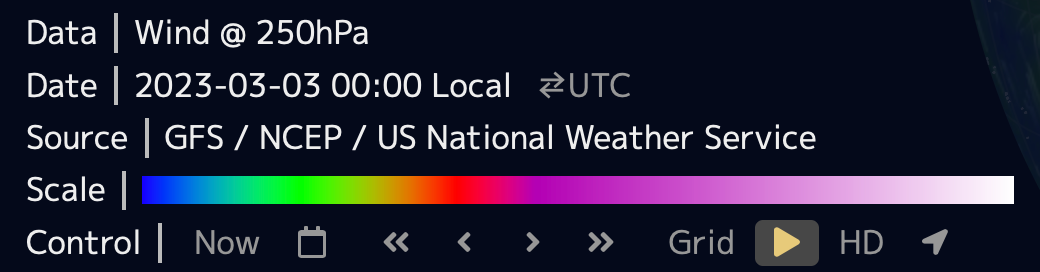
Click on the calendar and a pop-up window with year, month and date selection will appear. Examine the polar jet stream in the northern hemisphere.
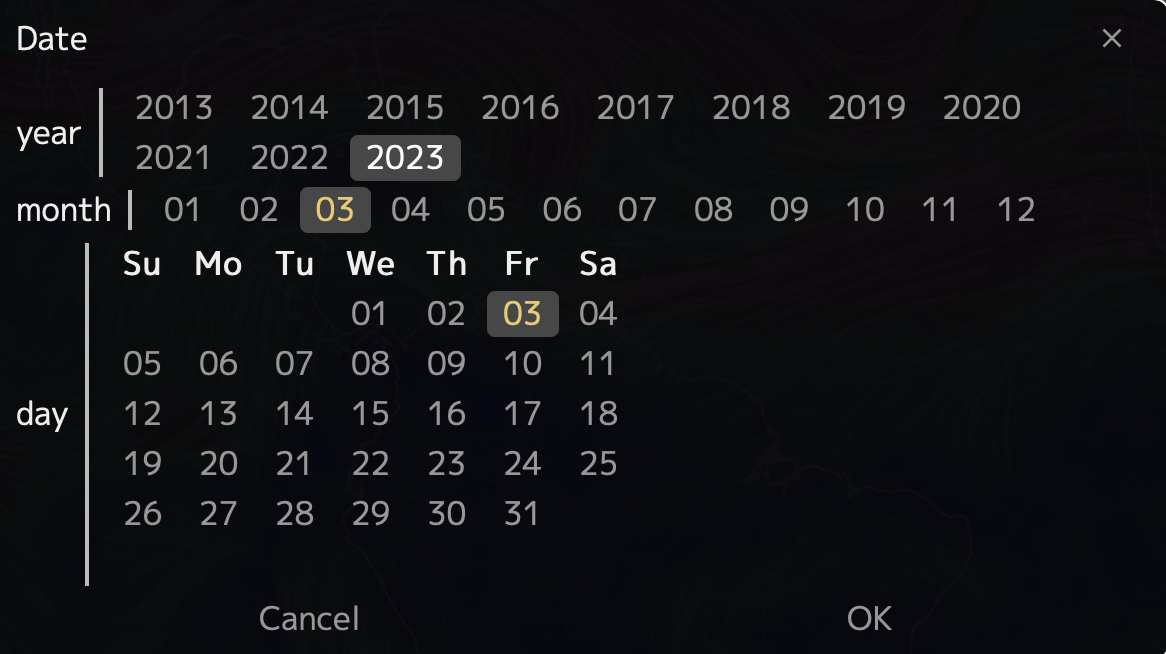
Does the position of the jet stream shift over the course of a calendar year?
Does the speed of the jet stream change over the course of a calendar year?
In the Northern Hemisphere, when does the jetstream shift northward in summer or winter?
Examine and make notes on the two locations, Hawaii and Greenland and how the position of the jet stream seasonally may impact wind patterns. Toggle between the jet stream at 250 hPA and surface winds (Sfc).
Do surface currents (Sfc) always move the same direction as the jet streams?
In the next step you will examine pressure. Update your data panel selections to the below.
MSLP stands for Mean Sea Level Pressure and it is the average pressure at sea level over a period of time. It is important to forecasters in understanding the movement and intensity of weather systems. Locate areas of high sea level pressure over the Atlantic and Pacific Ocean basins by locating clockwise rotations of pale-blue-grey. These semi-permanent clockwise swirling air masses are the locations of subtropical high pressure. The darker purple masses are low pressure systems.
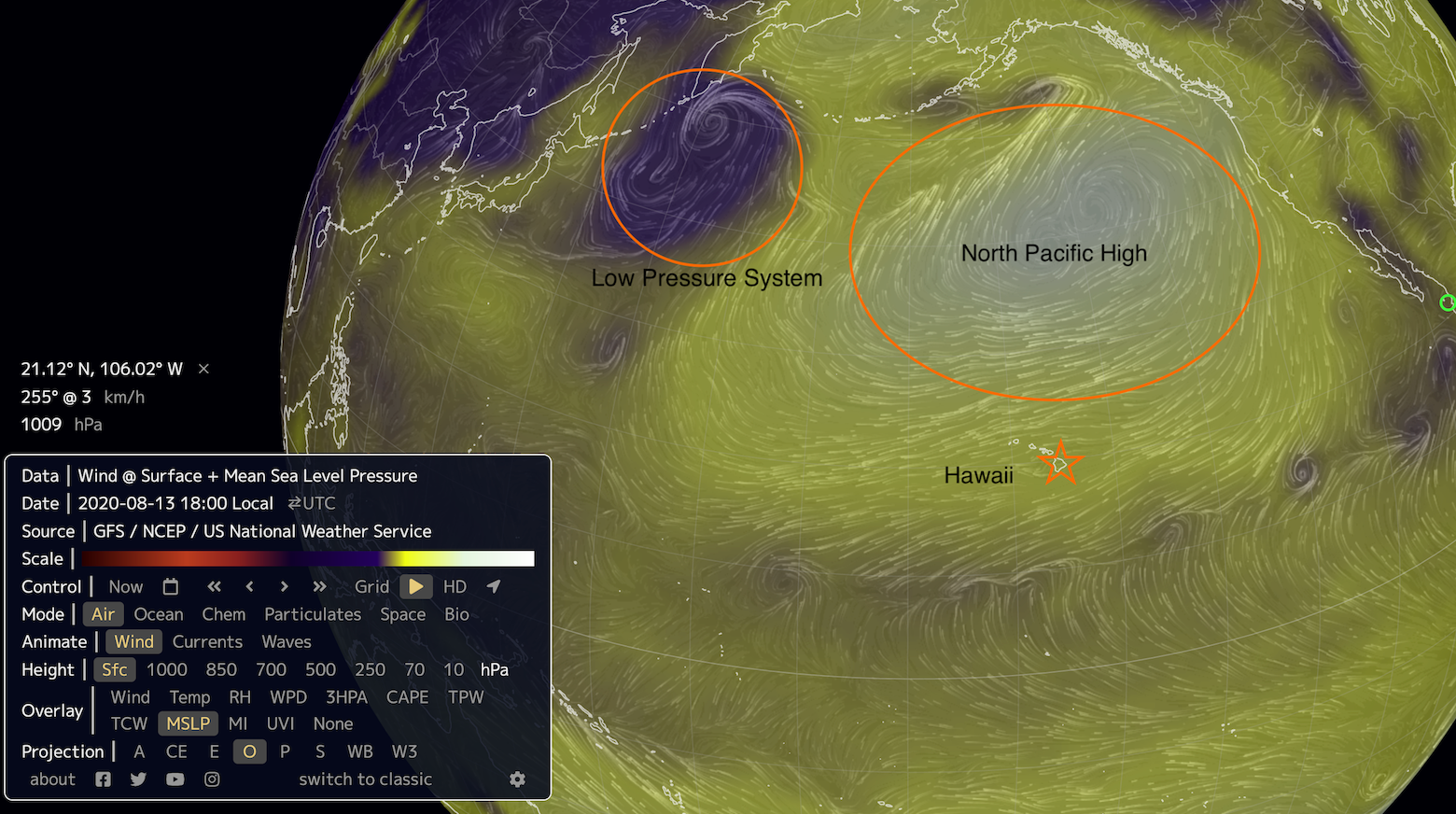
Return to the calendar prompt under Control and change the date to look at the general pattern and position of these low and high-pressure systems.
Do the location of the subtropical high-pressure systems change seasonally?
Zoom into Hawaii on your map.
Through your data search you have now uncovered that the subtropical high-pressure system and low-pressure systems move seasonally. The movement of air masses from high to low pressure plays a key role in shaping our weather. Over Hawaii, during the summer months (May-September), the subtropical high-pressure system centered over the Pacific Ocean moves northward, resulting in the trade winds blowing from the northeast. The trade winds are the prevailing winds in Hawaii and are generally moderate to strong.
During the winter months (October-April), the subtropical high-pressure system moves southward, resulting in the trade winds blowing from east or southeast. These trade winds are often weather during the winter months can shift south leading to light and variable winds in some areas.
Toggle between surface current winds in January verses June of 2020 over Hawaii, can you see the wind pattern and speed shift around the islands in the model?
On small oceanic islands like Hawaii source points of ozone pollution are relatively low. The graph you created demonstrate a distinct seasonal variability. Much of the Ozone seasonally arriving to the ocean basin is generated elsewhere and delivered to Hawaii through long range transport in the jet stream.
From what continent would air mass sources be coming from to Hawaii in the transition between winter and spring?
Now you have a really good understanding on how to view datasets in the DataPlotter function and a general understanding of seasonality of ozone in Hawaii.
With your graphs of Station Mauna Loa in front of you, make some conclusions about your data based on what you now know about the meteorology of the North Pacific. In your conclusion, list the primary ingredients needed in the formation of tropospheric ozone. Use the below resources to help to explain the seasonality of tropospheric ozone over Station Mauna Loa, Hawaii.