


This fall, BIOS will again welcome U.S. undergraduate students to its campus as part of the National Science Foundation (NSF) Research Experiences for Undergraduates (REU) program. But this year, there will be an exciting new twist to the internship experience.
A Plethora of (Zoo)Plankton Papers
May 29, 2021

While working on board a research vessel positioned 240 miles offshore Ireland in the Atlantic, BIOS zooplankton ecologist Amy Maas announced this month the publication of three new papers in science research journals. Maas, who has spent May at sea with 26 other scientists for the multi-year EXPORTS project (EXport Processes in the Ocean from Remote Sensing), used Instagram to promote the just-released science publications.
Acting U.S. Consul General Tom Edwardsen Visits BIOS
June 27, 2021

Acting U.S. Consul General Tom Edwardsen visited BIOS on June 22 for a tour of the Institute led by President and CEO Bill Curry. The two-hour tour gave Edwardsen, who is expected to remain in his post until this summer, an opportunity to learn about BIOS’s research and education programs.
A Big Show for Small Organisms
August 28, 2021

Two types of zooplankton will be featured at the Bermuda National Gallery (BNG) beginning this summer in a mixed-media exhibit dedicated to reminding us how art can be used to more deeply appreciate our place on this planet. Copepods, small marine crustaceans, and pteropods, tiny marine snails also known as “sea butterflies,” are the focus of this collaborative effort between BIOS and BNG. Some of the artists with works displayed in the series have spent time at BIOS working alongside zooplankton ecologists Leocadio Blanco-Bercial and Amy Maas as they investigate some of the ocean’s smallest and most critically important members of the marine food web.
A Picture is Worth a Thousand Words
September 26, 2021

A new painting graces the walls of the BIOS reception building commemorating friendships formed during the Institute’s 2019 National Science Foundation Research Experiences for Undergraduates (REU) internship and fall semester program. Commissioned by REU intern Harvey Castillo, then a biology major at Northern Arizona University (U.S.), and painted by visual artist Claudia Palacios, the piece reproduces a photograph of Castillo and fellow students watching a sunset from the dock at the BIOS waterfront.
A Climate Connection for College Students
November 28, 2021
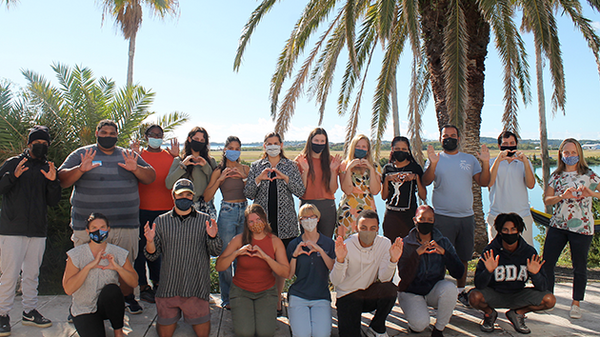
Nine Bermuda College students participated in lectures, hands-on laboratory activities, and a plankton-collecting trip during a two-day climate change workshop earlier this month through a partnership between BIOS’s Ocean Academy and the United States Consulate General in Bermuda.
‘The Smell of Disaster’
November 27, 2021
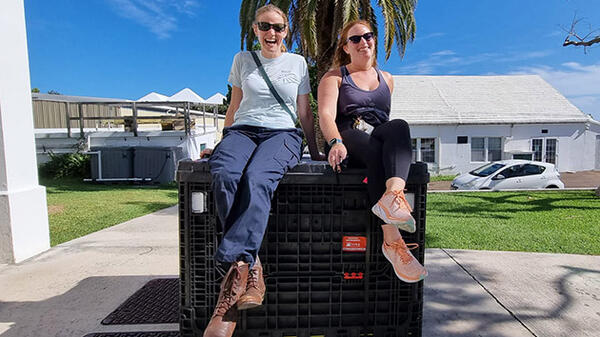
This summer, after a three-week quarantine preceding a six-week research cruise more than 200 miles offshore the United Kingdom, zooplankton ecologist Amy Maas returned to BIOS to await the arrival of more than 800 frozen zooplankton samples she had collected at sea. Preserved in vials and stored on dry ice, she expected them to arrive by expedited air mail in three days. Then she could begin detailed study of the organisms, from calculating their metabolic rates to measuring their individual and community sizes.
Welcoming Three New Instruments for BIOS Research
April 13, 2017

BIOS acquired three new instruments this spring to enrich investigations into the roles and interactions between microbial communities and migrating zooplankton in the Sargasso Sea.
Lights, Cameras… Sea Butterflies
June 17, 2017

Sea butterflies are tiny marine snails but, instead of a traditional foot, they have a pair of wing-like appendages. These propel them on their daily migration from the sea surface, where they feed, down to deeper, darker waters to hide from predators.
BIOS-SCOPE Funding Renewed
November 30, 2020

After five years, with more than 25 papers in peer-reviewed scientific journals, six dedicated research cruises, and more than 45 presentations at national and international meetings, the BIOS-SCOPE (Bermuda Institute of Ocean Sciences – Simons Collaboration on Ocean Processes and Ecology) program has received five years of additional funding from the Simons Foundation International to continue its study of the microbial oceanography of the Sargasso Sea.