


Justin Smith was raised in a fishing family in Gig Harbor, Washington, but a crash in the local fishing economy diverted him from the family business. Knowing he liked ships and being on the water, he decided to explore oceanography in college. Within his first month at the University of Hawaii, he discovered the Hawaii Ocean Time-series program and the research vessel Kilo Moana. His volunteer position on the ship led to a job in the physical oceanography lab. By graduation in 2009 he had logged 220 days at sea, and was inspired to pursue a hands-on, “jack-of-all-trades” career as a marine technician in the University-National Oceanographic Laboratory System (UNOLS) fleet.
An Unexpected Source for Copepods
March 30, 2021

Like all marine scientists, ecologist Leocadio Blanco-Bercial rejoices in the discovery of rare sea creatures. He just never expected to find them showing up in his toilet water.
A Plethora of (Zoo)Plankton Papers
May 29, 2021

While working on board a research vessel positioned 240 miles offshore Ireland in the Atlantic, BIOS zooplankton ecologist Amy Maas announced this month the publication of three new papers in science research journals. Maas, who has spent May at sea with 26 other scientists for the multi-year EXPORTS project (EXport Processes in the Ocean from Remote Sensing), used Instagram to promote the just-released science publications.
Research at BIOS Leads to Undergraduate Thesis Prize at Princeton
July 31, 2021

Emma O’Donnell, 22, graduated this past spring from Princeton University (U.S.) with a Bachelor of Arts in ecology and evolutionary biology, with high honors. Her undergraduate thesis, “One Fish, Two Fish: Measuring Patterns of Reef Fish Biodiversity in Bermuda Using Environmental DNA Metabarcoding,” was based on research she conducted at BIOS, and it earned her the Princeton Ecology and Evolutionary Biology Prize for Best Thesis in Ecology.
A Big Show for Small Organisms
August 28, 2021

Two types of zooplankton will be featured at the Bermuda National Gallery (BNG) beginning this summer in a mixed-media exhibit dedicated to reminding us how art can be used to more deeply appreciate our place on this planet. Copepods, small marine crustaceans, and pteropods, tiny marine snails also known as “sea butterflies,” are the focus of this collaborative effort between BIOS and BNG. Some of the artists with works displayed in the series have spent time at BIOS working alongside zooplankton ecologists Leocadio Blanco-Bercial and Amy Maas as they investigate some of the ocean’s smallest and most critically important members of the marine food web.
A Climate Connection for College Students
November 28, 2021
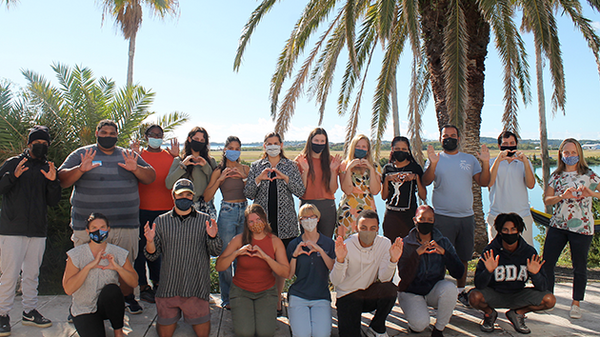
Nine Bermuda College students participated in lectures, hands-on laboratory activities, and a plankton-collecting trip during a two-day climate change workshop earlier this month through a partnership between BIOS’s Ocean Academy and the United States Consulate General in Bermuda.
Welcoming Three New Instruments for BIOS Research
April 13, 2017

BIOS acquired three new instruments this spring to enrich investigations into the roles and interactions between microbial communities and migrating zooplankton in the Sargasso Sea.
BIOS-SCOPE Funding Renewed
November 30, 2020

After five years, with more than 25 papers in peer-reviewed scientific journals, six dedicated research cruises, and more than 45 presentations at national and international meetings, the BIOS-SCOPE (Bermuda Institute of Ocean Sciences – Simons Collaboration on Ocean Processes and Ecology) program has received five years of additional funding from the Simons Foundation International to continue its study of the microbial oceanography of the Sargasso Sea.
‘A Fantastic Boost for My Career’
November 29, 2020

Naomi Villiot knew the path to research abroad during a global health crisis wouldn’t be easy or simple. However, “after a great deal of paperwork, navigating canceled flights, virus testing, and isolation for days upon arrival in Bermuda in September, I have been able to continue with my research,” said Villiot, who hails from a small island in France and studies at a British university.
New Insights Bloom from BIOS-SCOPE’s First Year of Data
August 13, 2017

Sampling offshore Bermuda this July, the BIOS-SCOPE (Bermuda Institute of Ocean Sciences – Simons Collaboration on Ocean Processes and Ecology) program completed its first full year of study to learn how marine microbes produce, transform, and leave behind dissolved organic matter as the seasons progress, and microbial communities wax and wane.