


Amy Maas, Ferhat Karakas and David Murphy never know what they’re going to turn up when they go trawling for zooplankton. ‘We work on the swimming of various sea butterfly species’, says Murphy, adding that unlike true butterflies, sea butterflies are miniscule snails that live at depth and swim to the surface at night, propelled by minute wings like flying insects. But one day in September 2017, the trio was in for a surprise. In addition to their usual haul of sea butterflies, Karakas and Maas turned up a pair of tiny heteropod snails, Atlanta selvagensis. ‘I had never heard of heteropods before’, admits Murphy. As virtually nothing was known about these rare aquatic molluscs, the trio rushed them back to Murphy’s high-tech zooplankton movie set in the lab, in the hope of catching them in the act of swimming.
Understanding the Movement Patterns of Free-swimming Marine Snails
September 17, 2020

A new study published in the journal Frontiers in Marine Science is changing the way that biological oceanographers view the swimming and sinking behaviors of open ocean, or pelagic, snails. Pteropods and heteropods are small marine snails, most measuring on the order of millimeters to centimeters, that are found throughout the world’s ocean from the surface to depths of 3000 feet (1000 meters). Although small in size, these organisms play a vital role in the ocean’s food web and biogeochemical cycles, as well as the global carbon cycle.
Planktonic sea snails and slugs may be more adaptable to ocean acidification than expected
October 02, 2020

Pteropods, or “wing-footed” sea snails and slugs, may be more resilient to acidic oceans than previously thought, scientists report.
Changing Seas – Bermuda: Life at Ocean’s Edge
June 10, 2023
As the shipwreck capital of the world, Bermuda is known for its treacherous reefs. But these unique corals may also offer clues to heightened resilience in the face of a changing climate. Working at the edge of science – and living at the edge of the ocean – experts study and protect these islands and reefs they call home.
Students Identify Organisms With ‘Keys to the Ocean’
February 28, 2023

A collaboration between Arizona State University’s “Ask A Biologist” website and researchers and educators at BIOS is helping students understand the fundamental concept of taxonomy, or grouping and classifying organisms based on their physical characteristics. Claire Fox (right), BIOS science education officer, designed an online, interactive game that leads players through the use of a dichotomous key, a tool that helps scientists identify unknown organisms—in this case, species of fish or zooplankton found in Bermuda. The game, called “Keys to the Ocean,” is tied into the “Identification Keys” lesson that is offered through BIOS’s Curriculum Enrichment Program as a 2.5-hour workshop, which includes the opportunity for students to conduct a plankton tow aboard a research vessel and view live plankton under microscopes.The history of taxonomy—or the science of naming, describing, and classifying organisms—is as old as human language and speaks to a fundamental desire to understand and bring order to the natural world. A new online game developed in partnership between Arizona State University’s (ASU’s) Ask A Biologist website and BIOS is combining this fascination with ongoing research to teach students how to use a dichotomous key, a tool that helps scientists identify unknown organisms.
Study reveals salps play outsize role in damping global warming
February 28, 2023

Humans continue to amplify global warming by emitting billions of tons of carbon dioxide into the atmosphere each year. A new study reveals that a distant human relative plays an outsize role in damping the impacts of this greenhouse gas by pumping large amounts of carbon from the ocean surface to the deep sea, where it contributes nothing to current warming.
Spending a Short Semester Studying Abroad
January 25, 2023
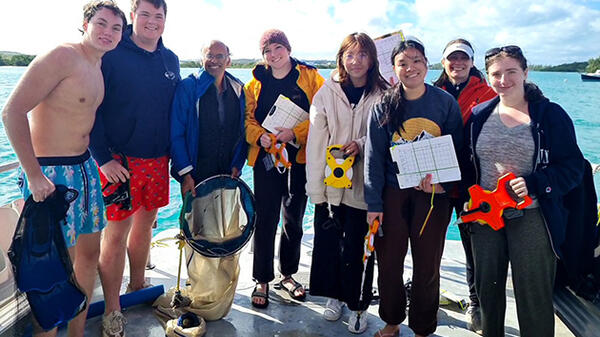
Paul Gensbigler, 20, is no stranger to the water, having spent the past two years studying the health of the Chesapeake Bay, the largest estuary in the United States. A junior majoring in molecular and cellular biology at Johns Hopkins University (JHU) in Maryland, Gensbigler is researching the microbes that help control nutrient levels in the Bay. However, this January he traded the brackish waters of the northern Chesapeake for the salty waters of the northern Atlantic in a “Hopkins Intersession Abroad” program.
Animals in Ocean’s Twilight Zone Thrive on Upcycled Nutrients
July 24, 2023

Living at the edge of darkness, the community of microbes and tiny animals in the ocean’s twilight zone upcycle nutrients to ensure their survival. A study led by researchers at the University of Hawai‘i at Mānoa revealed that small, free-floating animals called zooplankton rely mainly on an even smaller class of organisms, called microzooplankton, to consolidate the sparse waste products in the water and transform it into higher-quality food. The study was published in Limnology and Oceanography.
BIOS’s Ocean Academy Opens Doors of Opportunity
November 30, 2022

Through the generous support of a philanthropic sponsor, two BIOS Bermuda Program alumni are continuing to develop valuable scientific laboratory techniques and research skills outside of the Institute’s annual summer internship program. Jihad Muhammad, 22, and Marcus Rewan, 21, are working as part-time research interns through the BIOS Curriculum Enrichment Program.
ASU Announces New School of Ocean Futures
October 01, 2022

A new school dedicated to the study of the ocean and its ecosystems, and it is based in the desert?