

To maintain the unparalleled 27-year record of natural ocean processes and human-induced change at the Bermuda Atlantic Time-series Study (BATS) site, four BIOS research technicians work to collect monthly measurements at sea, process samples in the lab, and analyze incoming data. Over the past year, each of them has also gone beyond their basic duties with research forays into the time-series dataset. This month, the four traveled to New Orleans, Louisiana, to present their results at the 2016 Ocean Sciences Meeting.
BIOS Scientists Set to Participate in International Research Expedition to the Arctic
November 30, 2021

Not many people willingly sign up for a multi-week research cruise in freezing temperatures where fresh produce typically runs out after the second week at sea. But BIOS research specialist Becky Garley is excited at the prospect of returning to the Arctic for the third time next September 2022 as part of the Synoptic Arctic Survey (SAS).
BATS, Big Data, and the Base of the Marine Food Web
November 29, 2021

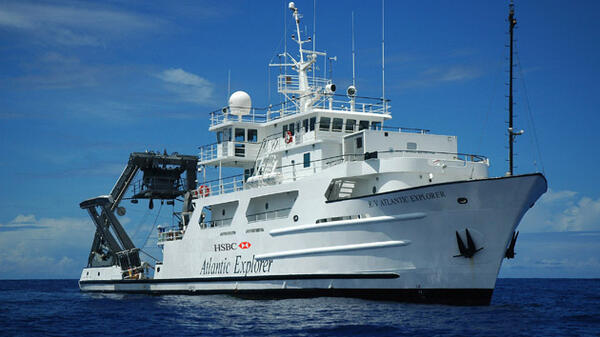
In mid-November, the BIOS-operated research vessel Atlantic Explorer headed into the Sargasso Sea for the eighth research cruise as part of the multi-year, multi-institutional BIOS-SCOPE (Bermuda Institute of Ocean Sciences – Simons Collaboration on Ocean Processes and Ecology) project. Since 2015, scientists from Bermuda, Germany, the United Kingdom, and the United States have converged at BIOS to investigate the microbial ecology of the Sargasso Sea and understand how organic matter (carbon) cycles within the marine environment.
A Royal Visit to BIOS
March 12, 2017

Prince Edward, Earl of Wessex, toured BIOS this month during a visit to Bermuda to celebrate the 50th anniversary of the country’s Duke Of Edinburgh International Award.
New Study Links Global Ocean Processes with Local Coral Reef Chemistry
November 27, 2015

Five years of data collected on reefs and offshore in Bermuda shows that coral reef chemistry – and perhaps the future success of corals – is tied not only to the human carbon emissions causing systematic ocean acidification, but also to seasonal and decadal cycles in the open waters of the Atlantic, and the balance of biochemical processes in the coral reef community.
Grant Catalyzes New Study of Ocean Microbes at BIOS
January 01, 2016

St. George’s, Bermuda –– An anonymous donor has awarded BIOS $6 million to support collaborative research on the distinctive microbial communities of the Sargasso Sea over the next five years. The research will leverage ocean measurements and ongoing research at the Bermuda Atlantic Time-series Study (BATS) site, bringing new collaborations and technologies to study the ocean’s smallest life forms.
Unprecedented, Man-made Trends in Ocean’s Acidity
February 26, 2012
As part of the natural carbon cycle, atmospheric CO2 reacts with the ocean’s surface waters to become carbonate, which can be converted by marine organisms into calcium carbonate. Many marine organisms—including corals, mussels, and algae—rely on calcium carbonate to build their shells or skeletons, making the molecule an important part of marine processes.

For Your Eddy-fication: Mesoscale Eddy Research at BIOS
April 27, 2012

For the past two decades, BIOS scientists have stood behind the idea that mesoscale eddies are a driving force in coastal and open ocean processes, including biogeochemical cycling and the global carbon cycle. As research technologies improved over this time period it became apparent that, not only were they correct, but that eddies are far more important to ocean and climate systems than previously imagined.
2012 Ocean Sciences Meeting
April 27, 2012
Last February, 11 BIOS scientists participated in the 2012 Ocean Sciences Meeting in Salt Lake City, Utah as either the leads or co-authors of 10 talks and 13 posters. A biennial conference held jointly by The Oceanography Society (TOS), the American Society of Limnology and Oceanography (ASLO) and the American Geophysical Union (AGU), this year’s Ocean Sciences Meeting attracted more than 4,000 scientists, managers and educators from around the globe.