
What keeps you up at night? Barking dogs, traffic in the city, perhaps noisy neighbors? For Samm Newton, a graduate student in the Oregon State University (OSU) Environmental Arts and Humanities program, it’s the challenges of connecting the public with the complex, global environmental threats facing society.
BIOS’s Hydrostation S Receives Five More Years of Funding
December 12, 2016

Hydrostation S, the world’s longest-running hydrographic time-series with a location offshore Bermuda, has received a commitment for another five years of support from the National Science Foundation (NSF). The funding includes $900,000 for research and $3.1 million to support 120 days of research at sea on board the BIOS-operated research vessel Atlantic Explorer.
Shipboard Teamwork
October 25, 2021

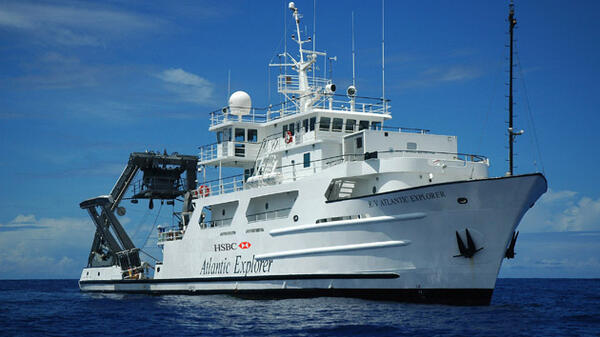
During the last two years, a team of researchers and technicians from BIOS have worked diligently alongside crew of the BIOS-operated research vessel Atlantic Explorer to maintain near-continued operations throughout the pandemic.
Out to Catch a Spring “Bloom”
April 13, 2017

Each spring, when daffodils and other flowers emerge in gardens, tiny ocean plants called phytoplankton also undergo a surge of production and rapid growth near the surface of the Sargasso Sea. Although each marine phytoplankton is small—tinier than the period at the end of this sentence—it carries tremendous responsibilities.
Predators and Puppeteers
September 20, 2017

Scientists estimate there are more than a million times more viruses in the ocean than stars in the universe. While wildly abundant, their tiny sizes present a big a hurdle to fully understanding their function in ocean ecosystems. If a cell were the size of a baseball stadium, a virus would be roughly the size of a baseball, so not only are viruses difficult to see under the microscope, but even gathering enough of their genetic material to analyze can be tricky.
BIOS-SCOPE Funding Renewed
November 30, 2020

After five years, with more than 25 papers in peer-reviewed scientific journals, six dedicated research cruises, and more than 45 presentations at national and international meetings, the BIOS-SCOPE (Bermuda Institute of Ocean Sciences – Simons Collaboration on Ocean Processes and Ecology) program has received five years of additional funding from the Simons Foundation International to continue its study of the microbial oceanography of the Sargasso Sea.
A Special Net for Special Organisms
September 21, 2017

At midnight on a warm night off Bermuda in July, research technician Joe Cope and a small team of crew members prepared to deploy a net system stretching nearly the length of a city bus from the stern of the research vessel Atlantic Explorer. Though it’s not unusual for oceanographers to work around the clock during a research cruise, the timing of this particular cast was important. Every night, under cover of darkness, the marine animals they hoped to capture—some a few inches in length, others the size of a sand grain—come to the surface to feed on phytoplankton, after spending the daylight hours far below the surface, hiding from predators.
A BIOS REU, Times Two
February 04, 2016

Chloe Emerson initially came to BIOS in the fall of 2014 for the Research Experiences for Undergraduates (REU) internship program funded by the National Science Foundation. As a Wellesley College senior working to complete her major in Biology and minor in Philosophy, Emerson already found developmental biology and stem cell research fascinating. At BIOS, these interests crystalized as she began to study sea urchins in Andrea Bodnar’s Molecular Discovery Laboratory, leading her down a path in regenerative biology that she hardly could have imagined two years ago.
A Showcase for Innovative BATS Research
February 04, 2016
To maintain the unparalleled 27-year record of natural ocean processes and human-induced change at the Bermuda Atlantic Time-series Study (BATS) site, four BIOS research technicians work to collect monthly measurements at sea, process samples in the lab, and analyze incoming data. Over the past year, each of them has also gone beyond their basic duties with research forays into the time-series dataset. This month, the four traveled to New Orleans, Louisiana, to present their results at the 2016 Ocean Sciences Meeting.
A Royal Visit to BIOS
March 12, 2017

Prince Edward, Earl of Wessex, toured BIOS this month during a visit to Bermuda to celebrate the 50th anniversary of the country’s Duke Of Edinburgh International Award.